Progressive Overload for Women 50+: What Most Programs Miss
Discover the exact progressive overload system women over 50 need — science-backed strategies that go beyond just adding weight each week.

Fit Life 50+ Staff
Fitness and wellness resources for adults over 50
Discover the exact progressive overload system women over 50 need — science-backed strategies that go beyond just adding weight each week.
Why Standard Progression Models Often Fall Short
Most strength programs hand you a simple formula: add 5 pounds when you can complete all your reps. Clean, logical, easy to follow. The problem? That model was largely built on research conducted predominantly on younger men. For women over 50, the hormonal, neuromuscular, and recovery landscape is meaningfully different — and a one-size-fits-all progression strategy can leave you spinning your wheels or, worse, sidelined with an overuse injury.
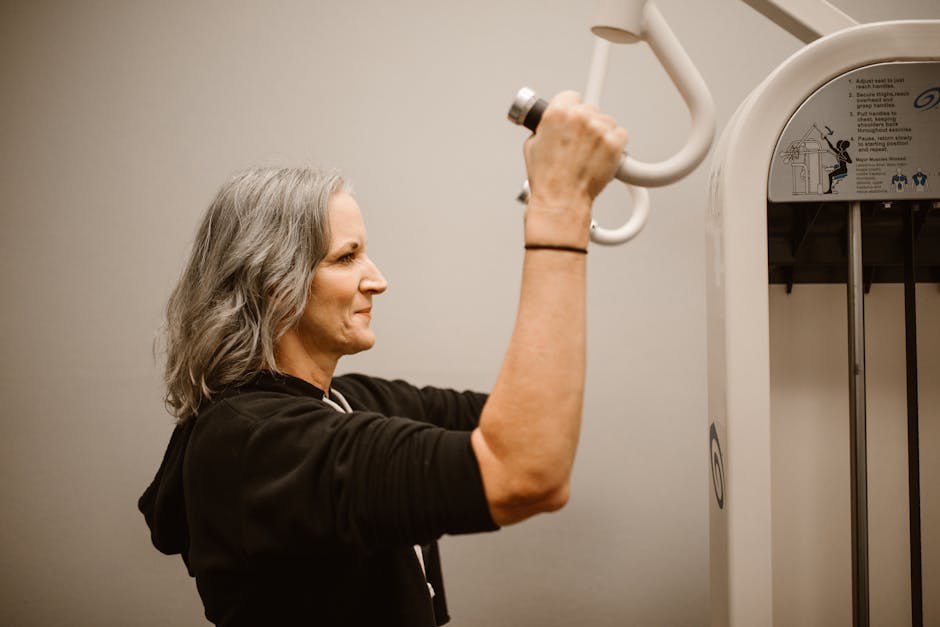
Photo by RDNE Stock project on Pexels
This isn't about limitation. It's about precision. Women in their 50s, 60s, and beyond are building impressive levels of strength every single day. But the path there looks different — and understanding that difference is your competitive advantage.
The gap most programs miss isn't motivation or effort. It's the structure of progression itself. Load isn't the only variable you can manipulate, and for this demographic, it's often not even the most productive one to lead with. Once you understand the full toolkit of progression, everything changes.
The Hormone Shift That Changes Everything
After menopause, declining estrogen levels affect more than mood and metabolism. Estrogen plays a meaningful role in collagen synthesis, joint lubrication, and the rate at which connective tissue recovers from stress. This means tendons and ligaments — which already adapt more slowly than muscle — need a bit more runway between hard sessions.
Lower estrogen also influences how quickly muscle protein synthesis responds to a training stimulus. Research suggests that older women can absolutely build muscle and strength, but the anabolic window and recovery curve may require slightly longer or more deliberate management compared to younger lifters.
What this means practically: aggressive weekly load jumps can outpace your connective tissue's ability to keep up, even when your muscles feel ready. This is one of the core reasons women over 50 experience more joint discomfort when following programs designed for a 28-year-old athlete. The solution isn't to lift less — it's to progress smarter.
The Full Progression Toolkit (Beyond Just Adding Weight)
Here's where the real system lives. Progressive overload simply means your body faces a slightly greater challenge over time. Load is one lever, but it's far from the only one. For women over 50, rotating through multiple progression variables is not just smart — it's the strategy.
Photo by Lukas Blazek on Pexels
The five levers of progression:
- Load — adding weight to the bar or dumbbells
- Volume — adding sets or total reps over time
- Density — doing the same work in less time (shorter rest periods)
- Range of motion — deepening a squat, lengthening a pull
- Technique quality — same weight, but cleaner, more controlled, better mind-muscle connection
A well-designed program cycles through these levers deliberately. You might spend three weeks prioritizing technique refinement and tempo, then shift to adding volume, then increase load. This keeps the stimulus fresh without hammering the same recovery system week after week.
Think of it as a spiral upward rather than a straight line — you're always progressing, just not always through the same door.
Practical Progression: A Framework That Actually Works
Here's a concrete system you can implement immediately. It's built on a three-phase micro-cycle that respects recovery while keeping you moving forward.
Phase 1 — Technique and Tempo (Weeks 1–2): Use a load you can lift with complete control. Add a 3-second lowering phase (eccentric) to every rep. This builds strength and body awareness without taxing your joints with heavy loads.
Phase 2 — Volume Expansion (Weeks 3–4): Keep the same weight. Add one additional set to your primary lifts. You're increasing total training volume — a well-established driver of hypertrophy and strength — without touching the load.
Phase 3 — Load Progression (Week 5): Now you earn the weight increase. Bump the load by the smallest increment available — often 2.5 to 5 pounds — and return to Phase 1 with the new weight.
This isn't timid training. This is strategic training. You're progressing across three dimensions before adding load, which means when you do add weight, your body is genuinely ready for it. Repeat the cycle, and over six months the cumulative gains are significant.
Recovery Is Where Strength Is Actually Built
You don't get stronger during the workout. You get stronger in the time between workouts — and this is where many programs fundamentally under-serve women over 50.
Research consistently shows that muscle protein synthesis, the biological process of building new muscle tissue, requires adequate protein, sleep, and rest intervals. For women over 50, protein targets that were once considered generous are now considered baseline. Aiming for 0.7 to 1 gram of protein per pound of bodyweight gives your muscles the raw material they need to adapt and grow.
Sleep is non-negotiable. Growth hormone — which supports muscle repair and fat metabolism — is released primarily during deep sleep. Poor sleep doesn't just make you tired; it actively undermines the gains you're working hard to earn.
Finally, two to three days of recovery between training the same muscle group is a reasonable starting framework. Soreness isn't the goal. Adaptation is. Learning to read your body's signals — distinguishing productive fatigue from accumulating breakdown — is one of the most valuable skills you'll develop as a lifter.
How to Track Progress Without Obsessing Over the Scale
The bathroom scale measures one thing: your relationship with gravity at a specific moment in time. It does not measure strength, muscle quality, bone density, energy levels, posture, or confidence — all of which are shifting in your favor when you train consistently.
For women over 50 specifically, body recomposition (gaining muscle while losing or maintaining fat) is a real and achievable outcome — but it often shows up in how your clothes fit, how you move, and how you feel before it shows up on a scale. In fact, because muscle is denser than fat, your weight can remain stable or even increase slightly while your body composition dramatically improves.
Better metrics to track:
- Weights lifted over time in your training log
- Reps completed at a given load
- How a set feels — same weight, less perceived effort is real progress
- Functional benchmarks: how you climb stairs, carry groceries, get up from the floor
- Energy levels and sleep quality
Track what matters. Celebrate what's actually changing. That's the mindset that builds a lifelong practice.
Conclusion
Progressive overload isn't a concept reserved for powerlifters or 25-year-olds. It's the foundational principle behind every lasting strength gain — and when you understand how to apply it specifically to where you are right now, it becomes one of the most empowering tools you have. Your body is responding to every smart session you put in. Your one actionable takeaway: this week, choose one progression lever — tempo, volume, or load — and apply it deliberately to a single exercise. Track it. Build from there. Strength isn't something you find. It's something you build, rep by rep, week by week. Strong today. Strong tomorrow. Strong for life.
Take the Next Step
Put the Knowledge
Into Action
Send a question or use the starter resources to plan your next practical step.